If you are searching for games like satisfactory, you probably do not want another generic crafting sandbox with a few machines bolted onto it. You want the good stuff: production chains that slowly become elegant, logistics problems that look impossible until one conveyor belt fixes everything, and a world that rewards planning instead of button mashing. I have sorted this list by the kind of automation itch each game scratches, because “factory game” covers a surprisingly large amount of ground.
Satisfactory remains the obvious reference point. Its first-person perspective makes building feel physical, while resource nodes, power grids, trains, and increasingly absurd production lines turn a quiet planet into an industrial monument. The games below are not identical replacements. That is the point. Some offer tighter logistics, some provide deeper engineering, and others trade alien wilderness for cities, farms, or space stations.
Factorio is the purest automation test
Factorio is the first recommendation for players who want the factory itself to be the main character. You mine ore, smelt plates, assemble components, research technology, and defend your expanding operation from local creatures. The top-down view is less immediately immersive than Satisfactory, but it gives you a clearer picture of every belt, inserter, train signal, and bottleneck.
Among games like satisfactory, Factorio has the strongest reputation for turning a simple production problem into a weekend-long redesign. You can launch a rocket in a fairly direct way, but the real game is improving your ratios and reducing wasted movement. It is more demanding and less scenic, yet the feedback loop is nearly perfect. If you have ever stared at a messy conveyor junction and thought, “I can fix that,” this is dangerous software.
Dyson Sphere Program makes scale feel ridiculous
Dyson Sphere Program starts with familiar ingredients: gather materials, build machines, research upgrades, and automate increasingly complex parts. Then it opens the door to multiple planets and interstellar logistics. You are not just optimizing one base. You are designing a supply network across a solar system, eventually constructing a Dyson sphere to collect stellar energy.
The best part is the change in perspective. Early factories feel cramped and practical; later projects become enormous geometric drawings spread across planets. Logistics vessels and interplanetary transport add complexity without making every minute feel like spreadsheet punishment. It is one of the best games like satisfactory for players who want a huge sense of progression and do not mind a more abstract science-fiction setting.
Captain of Industry rewards careful planning
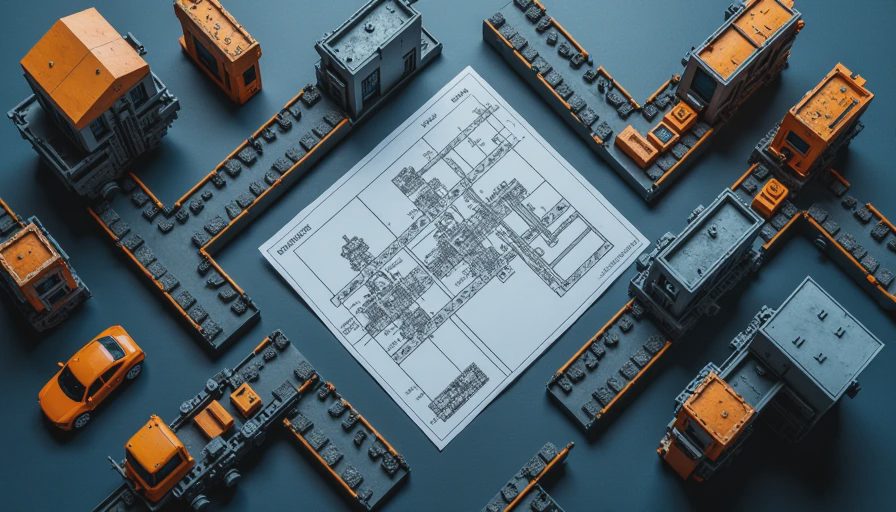
Captain of Industry is a strong pick when you want heavy industry with more physical consequences. You manage an island settlement, extract resources, reshape terrain, produce food, and build a network of factories that keeps the population alive. Landfills fill up, mines run out, trucks need routes, and storage decisions can quietly become tomorrow’s crisis.
This game feels more grounded than Satisfactory because the economy is tied to survival. You cannot simply build another machine and forget the rest of the colony. A fuel shortage can stop trucks, which delays construction, which prevents the next power upgrade. That chain reaction is frustrating in a productive way. It is for the player who enjoys planning around constraints instead of building a beautiful factory with unlimited breathing room.
Techtonica brings first-person building underground
Techtonica is the closest choice here for someone who wants the first-person sensation of games like satisfactory but prefers a subterranean setting. You explore a strange underground world, excavate rooms, place production equipment, and slowly turn abandoned caverns into a functioning automated base.
Its atmosphere is a major part of the appeal. Glowing plants, quiet tunnels, and distant machinery give the construction process a more intimate feeling than a wide open map. The production systems are not as deep or polished as the genre leaders, and the game can feel uneven depending on your expectations. Still, it earns a place on a wishlist for players who care about exploration, environmental storytelling, and physically walking through their factory.
Against the Storm changes the factory formula
Against the Storm is not a factory game in the literal sense, but it belongs in this conversation because it understands production chains and controlled expansion. You build settlements in a dangerous wilderness, assign workers, process raw materials, and satisfy several species with different needs. Each settlement eventually ends, so you carry bonuses and knowledge into the next one rather than polishing one permanent city forever.
That structure makes it a refreshing alternative to games like satisfactory. There is less pressure to create a perfect long-term layout and more pressure to make good decisions with limited time and space. A lumber camp supports planks, planks support buildings, and buildings support reputation. The game constantly asks what matters next, which is excellent for players who enjoy management but bounce off endless sandbox projects.

Cities: Skylines is automation at urban scale
Cities: Skylines works for players who like the logistics side of Satisfactory more than the mining side. Roads, zoning, electricity, water, garbage collection, public transit, and traffic all form connected systems. A badly placed highway interchange can create problems across an entire city, while a smart transit route can make a modest district feel remarkably efficient.
The satisfaction comes from watching a network operate. You are not placing hundreds of assemblers, but you are still balancing inputs, outputs, capacity, and demand. The original Cities: Skylines has a large modding community and a mature collection of expansions, while Cities: Skylines II offers a newer foundation with its own performance and feature considerations. Choose based on your tolerance for tinkering rather than assuming the newest option is automatically better.
Which automation game should you play next?
Choose Factorio if you want the deepest classic factory loop and do not need a first-person camera. Pick Dyson Sphere Program if planetary scale and spectacular late-game projects sound better than defending one base. Captain of Industry fits players who want a colony economy where trucks, terrain, fuel, and storage all matter. Techtonica is the atmospheric first-person option, while Against the Storm is ideal when you want short, replayable management runs.
If you specifically want games like satisfactory with exploration and a physical building feel, start with Techtonica and then try Dyson Sphere Program. If your favorite moments are fixing bottlenecks and redesigning production, Factorio should be your next install. Cities: Skylines belongs on the list when roads and public services are more exciting to you than conveyor belts.
Good management games do not just waste your time; they teach you how you like to spend it. These recommendations cover several versions of that pleasure, from a clean belt junction to a city that finally stops choking on traffic. Start with the demo or base game that matches your preferred scale, then let one small optimization ruin your evening in the best possible way.



Letters
No letters yet — be the first to write.