Garden Galaxy is the kind of Steam game you open when your brain has rejected another quest log, tutorial pop-up, or economy spreadsheet. You place objects, shape a small garden, collect more decorating options, and let the atmosphere do most of the talking. There is no dramatic campaign demanding your attention and no villain waiting to interrupt your landscaping. For the right player, that is the entire point.
I would describe it as a cozy decorating sandbox with light progression rather than a traditional farming sim. You are not optimizing crop rotations or rescuing a failing town. You are building a personal little space, adjusting it until the arrangement feels right, then deciding whether you want to keep tinkering or simply watch the garden breathe. Garden Galaxy understands that sometimes a game can be useful without being productive.
What You Actually Do in Garden Galaxy
The core loop is deliberately simple. You enter your garden, place available items, collect resources through the game’s relaxed systems, and unlock additional decorations. Depending on how you approach it, the garden can become a tidy courtyard, a dense woodland corner, a pond-centered retreat, or an eccentric pile of objects that somehow works. The appeal comes from making choices inside a forgiving space rather than chasing a single correct layout.
Garden Galaxy gives you room to experiment without turning every mistake into a financial penalty. Moving things around is part of the process, not a punishment for poor planning. That makes the game approachable for players who enjoy city-builders in theory but dislike restarting after one bad road placement. It also suits anyone who likes interior design games, dollhouse-style customization, or the quiet satisfaction of arranging a desktop wallpaper by hand.
The progression is light, but it provides enough direction to prevent the opening hours from feeling completely empty. New items give you reasons to check back in, while the garden itself becomes a record of your taste. I kept noticing small combinations that felt better than expected: a path leading toward water, a cluster of plants around a structure, or a deliberately awkward corner that gave the whole layout some personality.
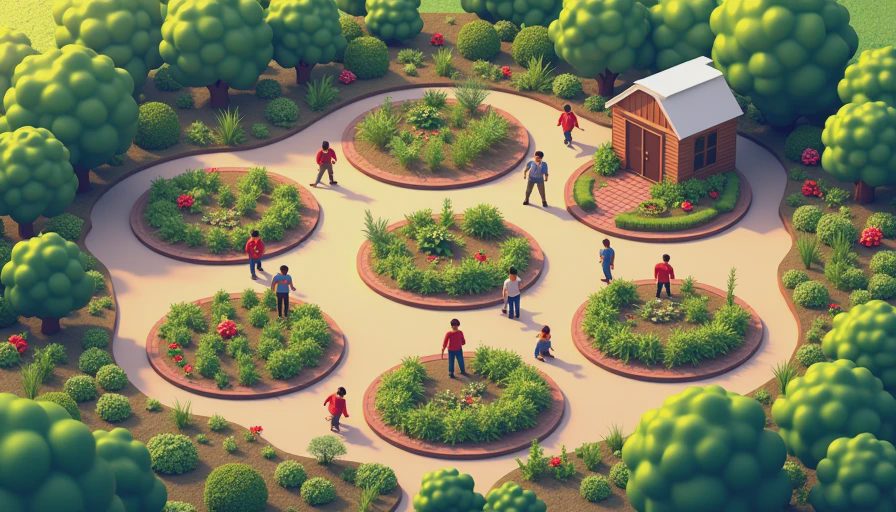
The Atmosphere Does Most of the Work
Garden Galaxy is strongest when you stop treating it like a conventional game and let it function as a calming digital space. The presentation aims for warmth rather than visual spectacle. Its charm comes from color, spacing, tiny environmental details, and the way a collection of simple objects becomes more appealing when arranged together.
This is for the kind of player who enjoys watching a conveyor belt run after the factory is already working, or who spends ten minutes moving furniture one square to the left in a shop sim. There is a similar satisfaction here, but with much less pressure. Garden Galaxy does not need to constantly surprise you because its reward is the garden gradually becoming yours.
That low-pressure design is also the game’s biggest limitation. If you need a strong narrative, complicated production chains, or clear milestones every few minutes, the relaxed pace could feel thin. There is no pretending otherwise. The game is good in theory and practice only if you are comfortable supplying some of the motivation yourself.
Who Should Play Garden Galaxy?
Garden Galaxy is an easy recommendation for players who want a background-friendly game with enough interaction to justify launching it. It works well after a long day, during a podcast, or in the gap between larger releases. The small scale means you can make visible progress in a short session without committing to a three-hour management marathon.
It is especially appealing if you liked Unpacking but wanted a more open-ended outdoor space, or if you enjoy the decorative side of Animal Crossing more than its daily chores. Players coming from Dorfromantik may also recognize the pleasure of building a pleasing scene, although Garden Galaxy is less about fitting tiles together and more about curating a personal environment.
The best audience is not necessarily hardcore simulation fans. This is for decorators, collectors, cozy-game players, and spreadsheet goblins taking a rare afternoon off from spreadsheets. If you want systems to master, look elsewhere. If you want a space that gradually reflects your decisions, this one makes a strong case for a spot on your wishlist.
Where the Loop Falls Short
The main question is whether the progression gives you enough reason to continue after the novelty of placing the first wave of objects wears off. Garden Galaxy can be soothing, but soothing is not automatically the same as engaging. A game built around atmosphere needs a comfortable rhythm, and some players will find that rhythm too quiet.
There is also a difference between having freedom and having meaningful choices. A large collection of decorations is valuable only when the game makes you care about using them. Garden Galaxy gets much of its mileage from self-directed goals, such as creating themed sections or rebuilding the space around one favorite item. Players who prefer explicit objectives might run out of momentum sooner.
That is why I would not sell this as a universal cozy recommendation. It is not a substitute for Stardew Valley, and it is not trying to be a full farming or life simulation game. It sits closer to a digital diorama with progression attached. Once you understand that, the smaller scope becomes a feature instead of a missing menu option.

Garden Galaxy Compared With Similar Games
Garden Galaxy occupies a useful middle ground. It has more interaction than a purely decorative screensaver, but less pressure than a management game built around resource shortages. Compared with Stardew Valley, it removes characters, schedules, combat, and long-term obligations. Compared with a city-builder such as Cities: Skylines, it removes traffic jams, budgets, zoning arguments, and the inevitable municipal disaster caused by one badly placed highway.
Compared with Dorfromantik, Garden Galaxy feels more personal and less puzzle-driven. Dorfromantik asks you to create an attractive landscape while managing tile placement. Garden Galaxy asks what kind of garden you want to inhabit. Neither approach is better; they simply satisfy different moods.
The practical buying advice is straightforward. Garden Galaxy is worth a wishlist, and likely worth picking up at a reasonable sale price, if you want a compact decorating game that respects your attention. It is a weaker choice if you need a clear endgame or deep simulation layers. Before buying, watch a few minutes of unedited gameplay and ask whether the basic placement loop looks relaxing or repetitive to you. That answer matters more than any review score.
Final Recommendation
Garden Galaxy succeeds because it knows what it is. It is a gentle garden-building sandbox for players who enjoy arranging, collecting, and slowly improving a space without being graded on efficiency. The game does not need a dramatic hook when the simple act of making a pleasant corner is the hook.
My recommendation is to try Garden Galaxy when you want a low-stakes weekend install, not when you are searching for your next hundred-hour obsession. Give it a small session, place objects without overplanning, and see whether you start mentally redesigning the garden while doing something else. If you do, the loop has worked.
Good management games do not just waste your time; they teach you how you like to spend it. Garden Galaxy spends time quietly. For some players, that will feel like barely a game. For others, it will be exactly the tiny garden their backlog needed.




Letters
No letters yet — be the first to write.